Nedbank API Marketplace
2022
Client
Nedbank API Marketplace
About the Client
Nedbank API Marketplace is a self-service developer and business platform designed to help third parties discover, understand, and integrate Nedbank APIs.
The platform forms part of Nedbank’s broader Open Banking and embedded finance strategy, enabling external partners to securely connect to banking capabilities through APIs. These include payments, accounts, customer data, rewards, verification, and open data services, supported by OAuth 2.0 authentication and REST architecture.
The Brief
Redesign of Nedbank API Marketplace, including its migration to the new nedbank.co.za (dot.co.za) platform and Adobe Experience Manager (AEM) CMS. The work focused on improving how a complex API ecosystem is structured and communicated for both technical and non-technical audiences.

The Challenge
The API Marketplace needed to explain a complex, multi-product ecosystem while supporting both technical and non-technical audiences.
Through research, stakeholder engagement, and content analysis, we identified that:
- users struggled to understand which APIs were relevant to their business
- dependencies between APIs were not clearly explained
- critical prerequisites (such as authentication) were not sufficiently surfaced
- content leaned heavily toward technical descriptions, limiting accessibility for business users
- the path from exploration to integration was not clearly guided
- limited visibility into real usage patterns (e.g. sandbox vs live requests), requiring alignment with developer behaviour
At the same time, the platform was undergoing a strategic repositioning, from targeting small businesses to focusing on digitally mature companies and fintechs with existing API capability. This required content to:
- maintain credibility and precision for developer audiences
- while clearly communicating value to decision-makers
My Role
As UX Content Lead on the MVP, I contributed across strategy, UX design and delivery, working end-to-end across the product lifecycle from research through to validation and release.
- Partnered with stakeholders to define product positioning and align content with business goals
- Participated in research activities, including interviews, workshops, and synthesis sessions
- Conducted content audits and heuristic evaluations to identify clarity and structure gaps
- Collaborated with UX, CX, and UI designers to define user journeys and flows
- Shaped information architecture and navigation
- Authored UX content across API descriptions, onboarding flows, FAQs, and support content
- Simplified technical concepts while maintaining accuracy
- Supported QA, testing, and deployment
The Approach
Understanding the ecosystem and user journey
Translated a technically complex system into structured user journeys by working with the product and design team to map:
- API landscape
- User entry points and decision paths
- Key dependencies required before integration
Identifying content gaps
Through audits and analysis identified the following:
- API purpose was unclear
- Prerequisites were not visible
- Language was overly technical
- Structure did not support decision-making
Simplifying and restructuring content
Focus was on:
- Reducing jargon and technical overload
- Clarifying API descriptions in terms of user value
- Making relationships between APIs more explicit
Improving scanability and hierarchy
Aligning content to user tasks
Experience was shaped to support:
- Exploration
- Understanding
- Evaluation
- Integration
Supporting end-to-end delivery
Authored content across key flows and collaborated through testing and deployment to ensure alignment with both user and business needs, contributing across key delivery phases:
- Discovery & research: Stakeholder immersion sessions & interviews
- Strategy & reimagination: Platform direction workshops
- Synthesis & insights: Synthesis sessions translating research into UX decisions
- Playback & alignment: Stakeholder feedback sessions
- Design & content validation: Iterative feedback and refinement

Content & UX decisions
Reframed APIs around use cases and value
Reframed APIs around use cases and value, shifting content from technical definitions to user outcomes.
Before
“Application programming interfaces enable integration of banking functions into third-party systems.”
After
“Integrate banking features like payments and account verification directly into your app – securely and at scale.”
Made prerequisites and dependencies explicit
Authentication was surfaced clearly as a required starting point to reduce confusion and improved readiness.
Reduced cognitive load
Complex concepts (e.g. OAuth 2.0) were simplified without losing precision.
Improved API discoverability
- Clearer categorisation
- More descriptive naming
- Improved navigation structure
Designed for self-service behaviour
Users could:
- Create apps
- Test APIs
- Monitor usage
Content supported:
- Exploration
- Experimentation
- Progression toward integration
Balanced technical precision with business clarity
Content was structured using progressive disclosure:
- High-level: value and use cases
- Deeper layers: technical detail
Developer-focused experience design
From cross-functional UX and design collaboration, the experience incorporated considerations specific to developer workflows, including:
- Dark mode to reduce eye strain during extended use
- Technical visual conventions (e.g. Pascal casing) to align with developer expectations
- Visual system principles such as circular forms to represent connectivity and system relationships
- Use of real-world imagery to ground abstract technical concepts
- Navigation structured around user needs (e.g. Solutions / Developers / Help)
Extended content ecosystem
Beyond core UX flows, contributed to a broader content ecosystem, including:
- Landing page value proposition
“Open your business to even more opportunities” - SEO & discoverability
Meta titles, descriptions, and keyword optimisation - API descriptions (PLM content)
Structured to highlight integration value and use cases - Developer-facing content
FAQs covering authentication, request methods, and usage - Legal and compliance content
Terms and conditions covering API usage and access control
Explore More Work
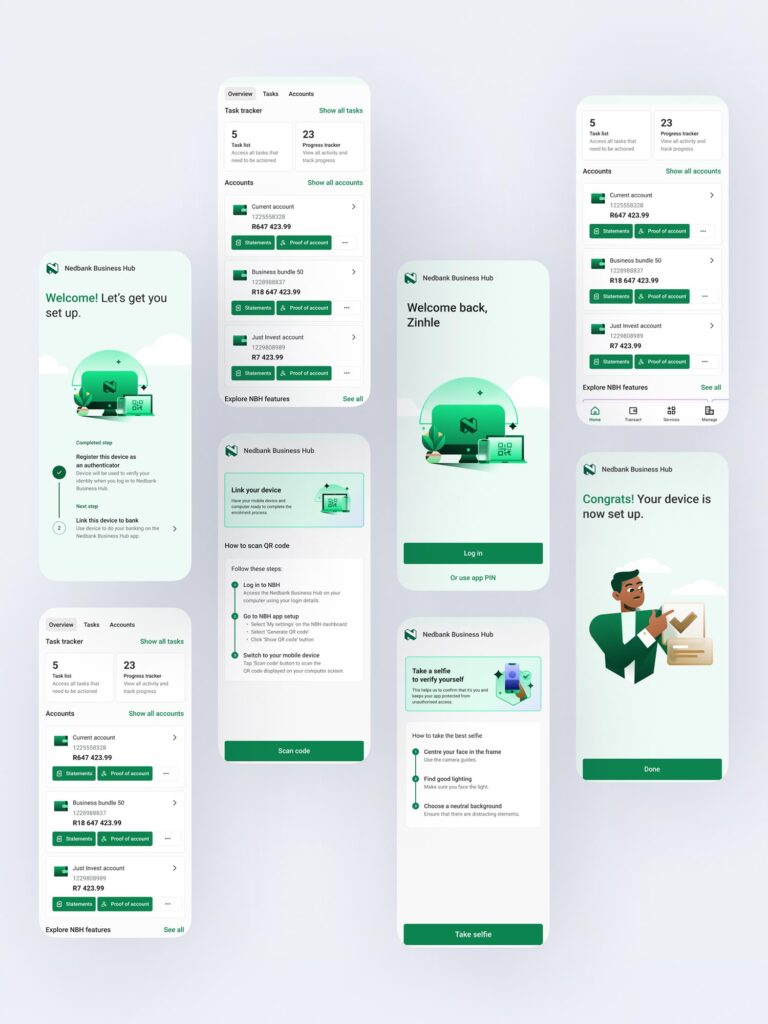
Nedbank Business Hub App
Nedbank Business Hub App
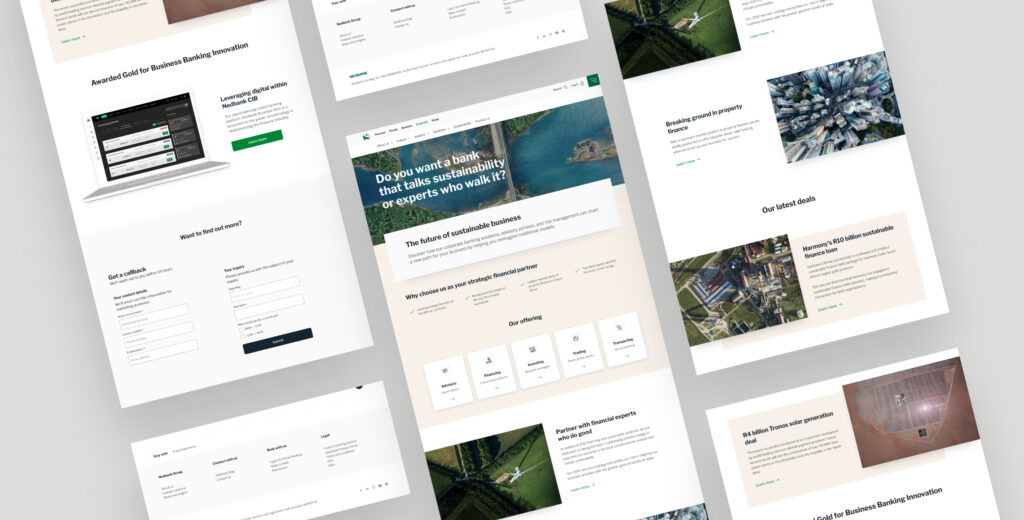
Nedbank CIB MVP
Nedbank CIB MVP
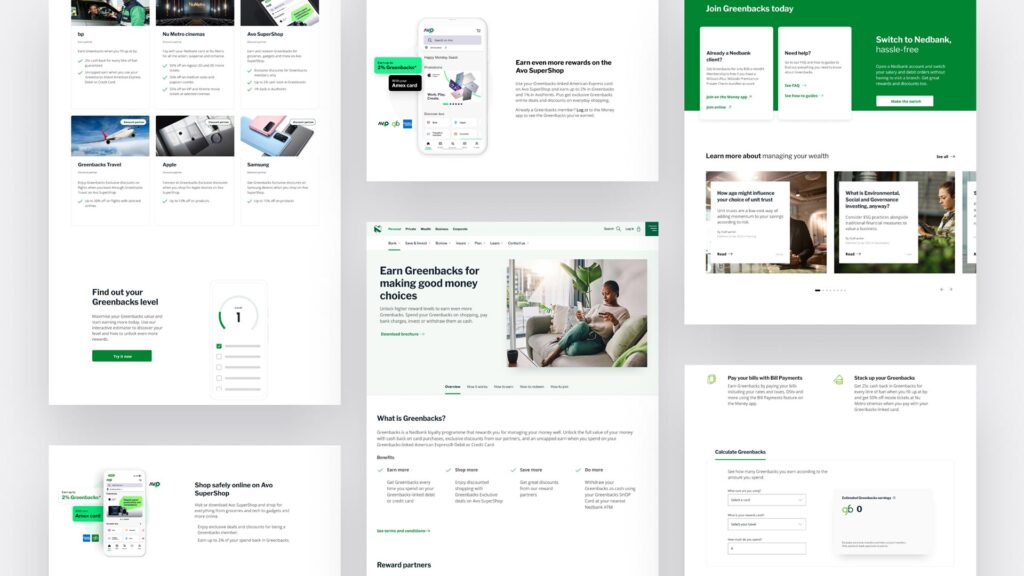
Nedbank Greenbacks Rewards 2.0
Nedbank Greenbacks Rewards 2.0

Nedbank Reimagine MVPs
Nedbank Reimagine MVPs

Old Mutual Website
Old Mutual Website

Russell Hobbs
Russell Hobbs

Sun International with Charlize Theron
Sun International with Charlize Theron
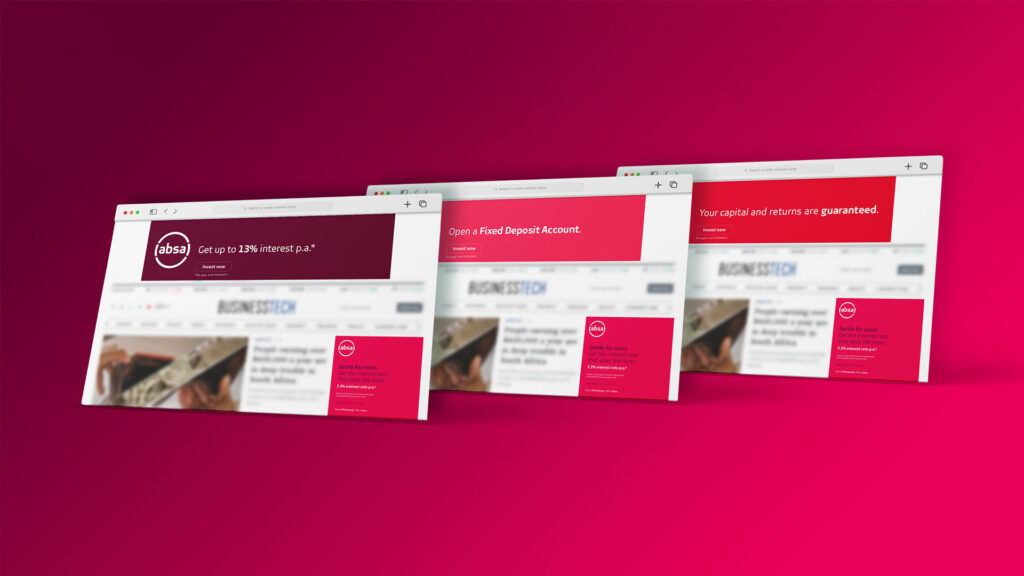
Absa Fixed Deposit
Absa Fixed Deposit

Absa Premium Banking
Absa Premium Banking

Absa Wealth